Canadian felt artist :
click here
Inspired by Claes Oldenburg's work:
click here
Wednesday, April 20, 2011

Sunday, April 10, 2011
What the heck is this thing?
Could it be some sort of gall or hive from an insect?

Here is my theory:

"Pine-Pine Gall Rust" ( Endocronartium harknessii ) is caused by a fungus, and is a common disease of Scots pine. Many native western pines and introduced species, such as Austrian and mugo pine, are also reported to be hosts. Pine-pine gall rust causes the formation of spherical woody galls on branches and stems of pine.
Globose or pear shaped woody galls form on branches of pine trees, on main stem in some species. Galls enlarge to 1-10 cm before dying. In May and early June powdery yellow-orange spores appear. In second year and third year galls develop bark collars at one or both ends.
About three years after infection, spores of the fungus are produced on the surface of the galls. These spores are yellow, powdery, and burst out of blister-like structures. These yellow spore masses may begin to appear in New York from mid-April to early May and may produce infectious spores for about 6-8 weeks. At the same time, healthy young shoots are elongating and are susceptible to infection. Spores from the galls are wind-blown and some inevitably land on the young shoots. Infections follows during wet weather. The following year infected areas on branches begin to swell and form galls.
The banana slug!

Banana slugs are detritivores, or decomposers. They process leaves, animal droppings, and dead plant material, and then recycle them into soil humus. They seem to have a fondness for mushrooms, and they spread seeds and spores when they eat, and excrete a nitrogen rich fertilizer. By consuming detritus (dead organic matter) slugs contribute to decomposition and the nutrient cycles and are an important aspect of the ecosystem.
Raccoons, garter snakes, ducks, geese and salamanders sometimes eat banana slugs; they roll the slugs in soil to bind the slime. Juvenile banana slugs are sometimes eaten by shrews or moles.

Banana slugs can move at 6 ½ inches (16.5 cm) per minute
The Pacific banana slug is the second-largest species of terrestrial slug in the world, growing up to 25 centimetres (9.8 in) long,[4] and weights of 115 gram (4 oz).[5] (The largest slug species is Limax cinereoniger of Europe, which can reach 30 centimetres (12 in) in length.)
Banana slugs excrete a thick coating of mucus around their bodies and can also estivate. They secrete a protective layer of mucus, and insulate themselves with a layer of soil and leaves. They remain inactive in this state until the environment is moist again.
Courtship
The slime also contains pheromones to attract other slugs for mating. Slugs are hermaphrodites, and reproduce by exchanging sperm with their mate.
They produce up to 75 translucent eggs, which are laid in a log or on leaves. Slugs mate and lay eggs throughout the year.
The adults provide no further care for their eggs beyond finding a suitable hiding spot, and the eggs are abandoned as soon as the clutch is laid.

Slugs use two pairs of tentacles to sense their environment. The larger, upper pair, termed "eyestalks," are used to detect light or movement. The second, lower pair are used to detect chemicals. The tentacles can retract and extend themselves to avoid damage.
Banana slugs have a single lung which opens externally via pneumostome. The pneumostome lung cavity is heavily vascularized to allow gas exchange.
Dehydration is a major problem for the mollusk.

Here is my theory:

"Pine-Pine Gall Rust" ( Endocronartium harknessii ) is caused by a fungus, and is a common disease of Scots pine. Many native western pines and introduced species, such as Austrian and mugo pine, are also reported to be hosts. Pine-pine gall rust causes the formation of spherical woody galls on branches and stems of pine.
Globose or pear shaped woody galls form on branches of pine trees, on main stem in some species. Galls enlarge to 1-10 cm before dying. In May and early June powdery yellow-orange spores appear. In second year and third year galls develop bark collars at one or both ends.
About three years after infection, spores of the fungus are produced on the surface of the galls. These spores are yellow, powdery, and burst out of blister-like structures. These yellow spore masses may begin to appear in New York from mid-April to early May and may produce infectious spores for about 6-8 weeks. At the same time, healthy young shoots are elongating and are susceptible to infection. Spores from the galls are wind-blown and some inevitably land on the young shoots. Infections follows during wet weather. The following year infected areas on branches begin to swell and form galls.
The banana slug!
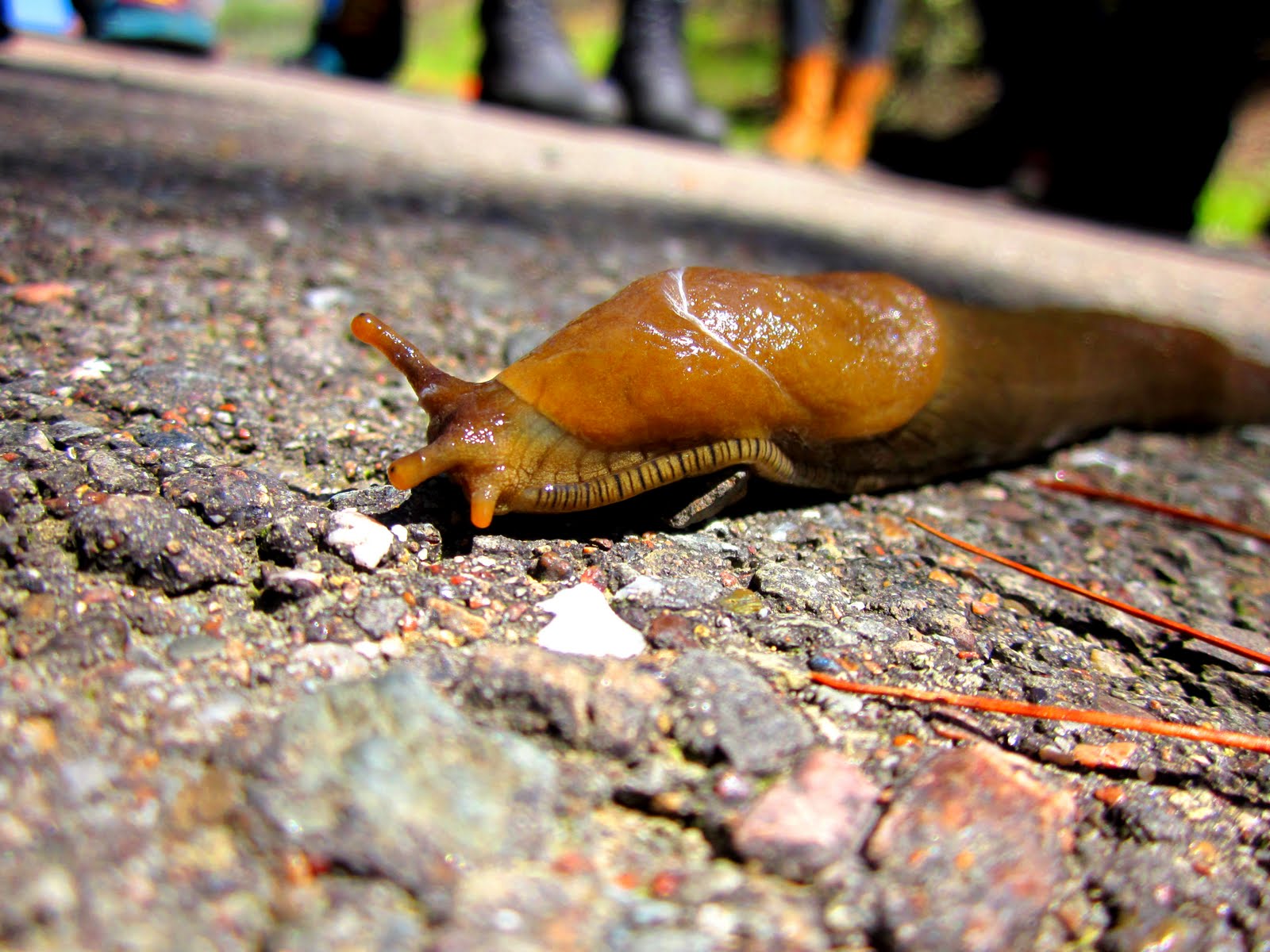
Banana slugs are detritivores, or decomposers. They process leaves, animal droppings, and dead plant material, and then recycle them into soil humus. They seem to have a fondness for mushrooms, and they spread seeds and spores when they eat, and excrete a nitrogen rich fertilizer. By consuming detritus (dead organic matter) slugs contribute to decomposition and the nutrient cycles and are an important aspect of the ecosystem.
Raccoons, garter snakes, ducks, geese and salamanders sometimes eat banana slugs; they roll the slugs in soil to bind the slime. Juvenile banana slugs are sometimes eaten by shrews or moles.
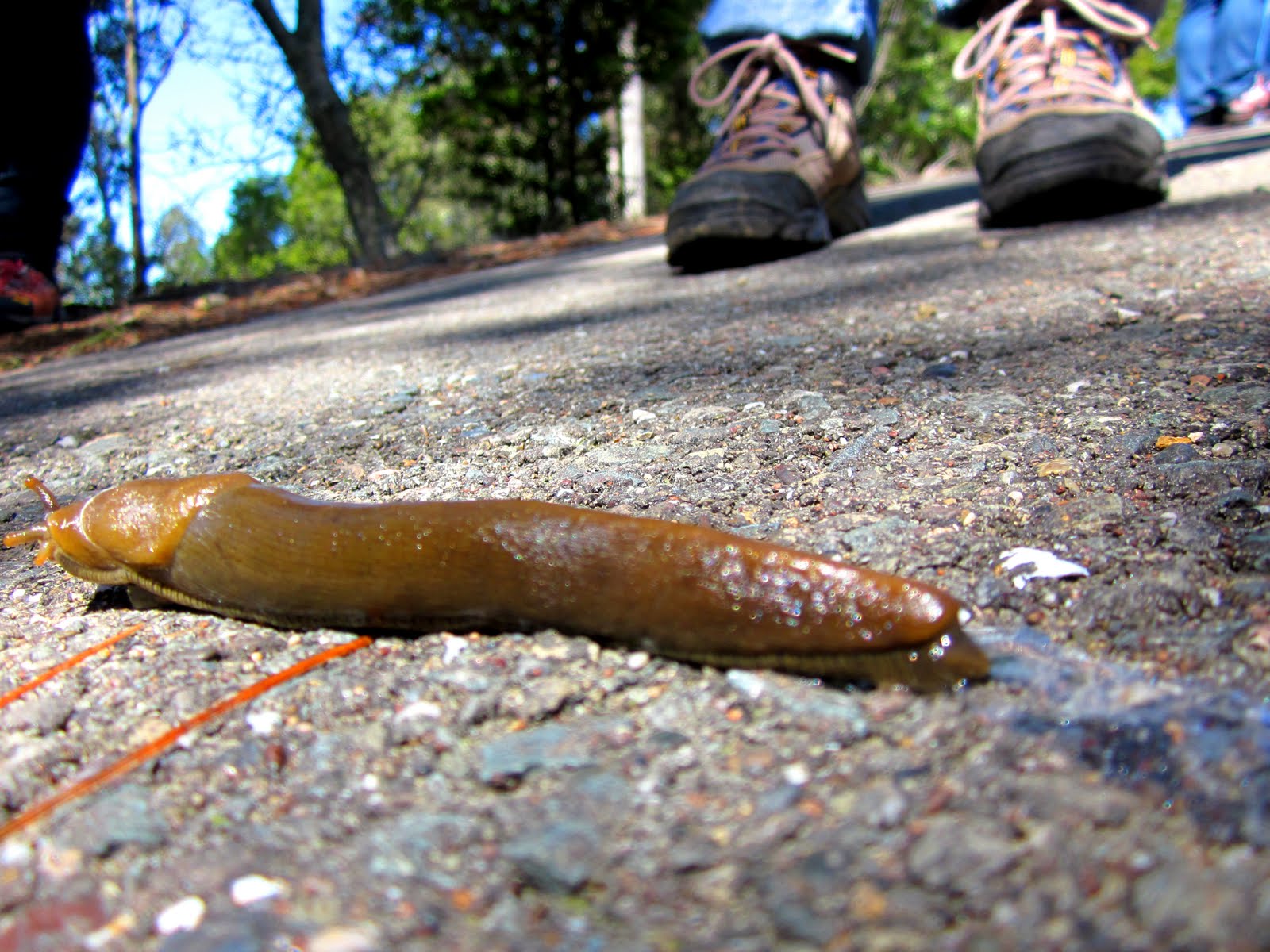
Banana slugs can move at 6 ½ inches (16.5 cm) per minute
The Pacific banana slug is the second-largest species of terrestrial slug in the world, growing up to 25 centimetres (9.8 in) long,[4] and weights of 115 gram (4 oz).[5] (The largest slug species is Limax cinereoniger of Europe, which can reach 30 centimetres (12 in) in length.)
Banana slugs excrete a thick coating of mucus around their bodies and can also estivate. They secrete a protective layer of mucus, and insulate themselves with a layer of soil and leaves. They remain inactive in this state until the environment is moist again.
Courtship
The slime also contains pheromones to attract other slugs for mating. Slugs are hermaphrodites, and reproduce by exchanging sperm with their mate.
They produce up to 75 translucent eggs, which are laid in a log or on leaves. Slugs mate and lay eggs throughout the year.
The adults provide no further care for their eggs beyond finding a suitable hiding spot, and the eggs are abandoned as soon as the clutch is laid.

Slugs use two pairs of tentacles to sense their environment. The larger, upper pair, termed "eyestalks," are used to detect light or movement. The second, lower pair are used to detect chemicals. The tentacles can retract and extend themselves to avoid damage.
Banana slugs have a single lung which opens externally via pneumostome. The pneumostome lung cavity is heavily vascularized to allow gas exchange.
Dehydration is a major problem for the mollusk.
Wednesday, April 6, 2011
Monday, March 7, 2011
California's native plants

Picea engelmannii (Engelmann Spruce) is a species of spruce native to western North America, from central British Columbia and southwest Alberta, southwest to northern California and southeast to Arizona and New Mexico; there are also two isolated populations in northern Mexico. It is mostly a high altitude mountain tree, growing at 900-3650 m altitude, rarely lower in the northwest of the range; in many areas it reaches the alpine tree line.Picea engelmannii is a medium-sized to large evergreen tree growing to 25-40 m tall, exceptionally to 65 m tall, and with a trunk diameter of up to 1.5 m.


The leaves are needle-like, 15-30 mm long, rhombic in cross-section, glaucous blue-green above with several thin lines of stomata, and blue-white below with two broad bands of stomata.

The cones are pendulous, slender cylindrical, 4-8 cm long and 1.5 cm broad when closed, opening to 3 cm broad. They have thin, flexible scales 15-20 mm long, with a wavy margin. They are reddish to dark purple, maturing pale brown 4–7 months after pollination. The seeds are black, 2-3 mm long, with a slender, 5-8 mm long pale brown wing.

The bark is thin and scaly, flaking off in small circular plates 5-10 cm across. The crown is narrow conic in young trees, becoming cylindric in older trees. The shoots are buff-brown to orange-brown, usually densely pubescent, and with prominent pulvini.

Rhus ovata ~ Sugar Bush
Rhus ovata is a large green shrub. The Sugar Bush can grow to 15 feet or more in height and width. The flowers and seeds can be soaked in water to make a refreshing drink. Rhus ovata is native to California and Arizona in the inland Chaparral portions of the state. Rhus integrifolia, Lemonade Berry, is common closer to the coast. Rhus ovata only needs a little irrigation to get established. The seeds of the Sugar Bush are popular with the seed eating birds and are great for attracting wildlife to your garden. With their deep roots Rhus ovata is a great plant for stabilizing slopes. And with its height Sugar Bush can from an excellent hedge or screen. The plants adapt well to regular trimming. The leaves last too long for to trim your hedge with a hedge trimmer, this is best done by hand.

 />
/>

Tuesday, February 22, 2011
Yurts!
Here are some links that might be helpful in the construction of a yurt:
Pacific Yurts- what is a Yurt?
Woodland Yurts
Canvas components
the parts of a yurt
Time lapse video- Construction of a Yurt


Pacific Yurts- what is a Yurt?
Yurt info.org
Woodland Yurts
Canvas components
the parts of a yurt
Time lapse video- Construction of a Yurt


Wednesday, February 9, 2011
Christo and Jeanne-Claude


Pont-Neuf bridge in Paris

Reichstag in Berlin

Running Fence in Sonoma and Marin


OVER THE RIVER
Project for the Arkansas River,
State of Colorado
In Progress
Thursday, December 9, 2010


Subscribe to:
Comments (Atom)
